

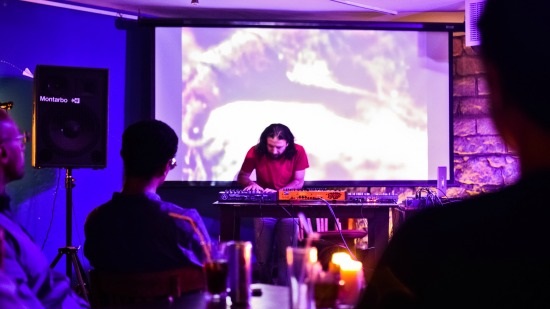
Distorted voices and creepy cosmic whistles, distant sounds of beating drums, pieces of melodies coming up to the surface and blending back into the mix.
One man on stage, surrounded by devices and wires, is pressing keys and turning knobs. Accompanying the sound, behind his back a salad of visuals is projected, running from footage of street protests to vintage black and white animation, from working mechanisms to quivering biological objects -- on the edge of disturbing, but not crossing the line. Some people are dancing, but most are contemplating the act seated, showing their appreciation by applause.
On Friday, ROOM Art space and cafe, the cozy hub for the art crowd in Downtown Cairo, hosted a one-man-show of experimental electronic music by Mohamed Ragab, also known as Machine Eat Man. He stands out as the only Egyptian artist who builds his experimental electronic performances solely on the use of analog synthesisers, and has been doing so for a decade now.
"This time I am playing only Arturia MiniBrute, Dave Smith Instruments Mopho, Korg EMX-1 and Eventide Space, with backing tracks run by Ableton software," says Ragab, introducing his pet robots to Ahram Online. "This is the least I perform with."
There are shows which need more than one car to transport the required equipment to the venue, but Friday saw a smaller scale event featuring compositions from his ambient album Solitude as well as a small preview from the upcoming album Kon Rasoul in collaboration with the famous Tunisian singer Ghalia Benali, reworked into a dance remix.
For people new to the genre, all electronic music basically falls into the category of "computer sounds." But analog synthesisers are a separate reality which have recently been attracting more and more listeners around the world. Once you've tuned your ear to recognise and appreciate their distinctive electric sound, you are hooked.
These instruments have come a long way from the first models of the 1920s; they were almost forgotten in the 1980s, sold for nothing it the early 1990s and then reached fetish status around the millenium, becoming sought-after collectors' items with unique voices and sound characteristics.
"A new turn in the process started after 2012, when more affordable models of analog synths hit the market," says Amir Farag, who is part of Focus Media Group, one of the major distributors of professional musical equipment in Egypt.
"Analog gear is making a comeback, in Egypt and around the world. It caught on again in about 2012 with the release of the Arturia MiniBrute and Novation Bass Station 2. They were affordable mono synths for a great price. The older more established brands like Moog were expensive and out of the reach of most artists," Farag explains.
The cheapest analog synth now sold in Egypt is the Microbrute, a simple small synth that has the basic controls to start getting a sound. It is a budget or entry level synth to get one into the world of the instrument.
According to Farag, the sales of analogue synthesisers in Egypt are showing a steady growth of 25-30 percent every year, which means that a new generation of musicians is soon to show up with their analogue experiments.
Adrift on the sound waves, Mohamed Ragab has been there since the late 1990s, when his electronic career started by chance.
"I used to have a band, and suddenly everybody left. I wanted to play music, so I brought a drum machine just to replace people. In the beginning I was really sad when people said that I am playing electronic music. Inside, I was a rock band. I would usually go on stage with synthesisers and people would ask me what it is. I really hated that period," Ragab recalls.
As of now, Ragab posesses about 11 analog electronic items, including vintage collectibles.
"I recently acquired a couple of old items from 1978 and 1979. They are even better than the new ones that I have. It is an organ/synthesiser called Farfiza, the kind that Pink Floyd used. And also a string section with a synthesiser part called Solina," he adds.
Egyptronica is a term he coined for his music, denoting the heavy use of Egyptian percussion as a basic building block for his compositions. The drum sounds are provided by Darbukator, an Egyptian-made software embracing all the traditional percussion instruments.
"I don't only use the beats as they are, I process them with filters and effects, just to make the sound weird. Sometimes the baseline would be tabla, but I use so many effects to destroy the original sound that you will never know it is there. I think it is all about the beat. If you have a very good rhythm section, then anything else on top of it can be listenable," he explains.