

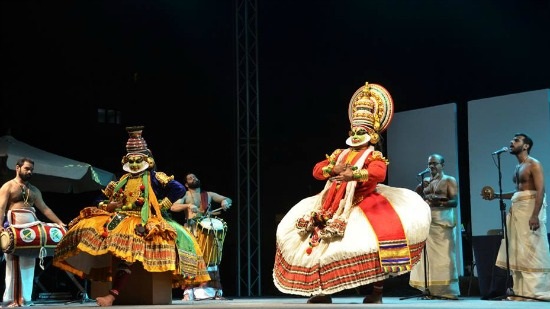
Of all the classical, traditional and contemporary art forms coming from India, Kathakali is probably the most visually striking. This captivating art form blends theatre, dance and pantomime, combining devotion with culture.
It is best described as a dance-drama, manifested through the evocative language of mudras (hand gestures), navarasam (facial expressions), music, elaborate costumes and expressive mask-like makeup where each colour carries a symbolic meaning.
Kathakali is one of the most eminent celebrations of the Natya Shastra (The Science of Acting), a two-thousand-year-old Sanskrit text attributed to Bharatha Muni; a theoretical treatise, the Natya Shastra has became an academic source for all performing arts.
In the last decade the Egyptian audience has seen much from India – but not Kathakali.
Last week the accomplished Kathakali artist Kottakkal Rajumohan led nine performers across four cities, starting with the Bibliotheca Alexandrina on 1 August, moving on to Port Said on 3 August, Ismailia on 4 August and culminating in Cairo on 6 August.
The performance included two stories adapted from the epic the Srimad Bhagavata: the first, Pootanamoksham, is an episode from the major Hindu deity Krishna’s childhood; in the second, Santanagopalam, a Brahmin’s wife tragically gives birth to nine stillborn babies.
Katha means a story or a tale while kali means a drama or a play; Kathakali is the process of telling stories through dance-drama.
The beauty of Kathakali is rooted in the land and culture of the tropical state of Kerala in south India. Prior to the emergence of Kathakali in the 17th century, Kerala had already had a variety of ritual folk art forms, many of which were restricted to temples and courts or performed around them during the festivities.
Kathakali was born of the political rivalry of two 17th-century Kerala chieftains, the Zamorin of Kozhikode (or Calicut) and the Raja of Kottarakkara, who through their respective reigns became competitors in displaying the best art in the country.
The Raja of Kottarakkara initiated Raamanaattam, an art form based on enactment of familiar stories drawn from the Malayalam texts, in a language understood by everyone which – unlike Zamorin’s Krishnattam, written in Sanskrit, “the language of gods” – gained immediate popularity.
Raamanaattam soon turned into what we know today as Kathakali. Though Kathakali’s final structure did not crystallise until the 18th century, making it a very young phenomenon in Indian terms, it is deeply rooted in two millennia of Indian culture.