After years languishing behind competitors at home and abroad, Russia's iconic MiG aircraft manufacturer has been thrown a lifeline. The company is now building 46 brand-new MiG-29M fighter jets in a contract reported to be worth at least $2 billion. Yet despite the hints which have appeared in the Russian press over the past year, official confirmation remains elusive. The jets are being built for an unspecified buyer. Only a shareholder’s report released by a MiG component supplier has confirmed that the order is real. The document outlines a deal for 92 engines used in the MiG-29. With two engines in each fighter, the contract corresponds with reports of a 46-fighter contract in the works.
The military upheaval in Turkey, of which the final consequences are yet to be seen, highlights a major weakness in worldwide efforts to promote democracy. This event underscores the need to establish binding international legal principles to ban the recognition of military regimes as a result of coups d’état. Establishment of such principles, and the creation of the legal mechanisms for applying them, would foster democracy throughout the world.
Port Said, the Suez Canal city associated with the worst incident in Egyptian sporting history, is emerging as a prime locus of soccer-driven protest in a country that does not brook dissent.
The concept of a coup d’état is not new to Turkey. Friday’s event was the sixth coup d’état following the collapse of the Ottoman Empire, starting with the 1960 Turkish coup d’état, then the 1971 Turkish military memorandum, followed by the 1980 Turkish coup d’état, the 1993 alleged Turkish military coup, the 1997 Turkish military memorandum, and finally the current 2016 Turkish coup d’état attempt. On 15 July, a group of Turkish military leaders tried to carry out a military coup against the current Turkish president and his government. Was this a surprise to Recep Tayyip Erdoğan? What are the causes behind it? What will it end up accomplishing? How can we examine the political and security background of the current situation?
Stay home’ is the advice I often give to Egyptians who are unable to tolerate the behaviour of their fellow citizens. In Egypt, the moment a citizen steps out of his home, the wide-ranging drama that literally entails an endless list of interactions (with fellow citizens, vehicles, roads, the environment, etc) begins. The direct result is a society that is extremely exhausted, both mentally and physically. Decades of misconduct by the vast majority of Egyptians has led to the false conclusion that misbehaviour is an irreversible Egyptian cultural trait.
It sounds crazy, but it happened. I have slept in a tent that was only a few metres away from a pack of lions. I was in the middle of the savannah of Serengeti National Park in Tanzania. If I knew that this would be my fate, I may have thought twice before travelling to Tanzania for a wildlife safari. A wildlife safari is one of the greatest adventures one can experience, and it is something that will remain fondly in my memory for many years to come.
There are mounting concerns currently being voiced by prominent organisations, such as the International Monetary Fund (IMF) and the Bank of International Settlements, over the long-term impact of the slow growth rate reported across all major economic regions from the latter part of 2015 to early this year. Significant losses in the global financial and commodity markets have been observed following crucial developments, such as the slowdown of the Chinese economy, volatile oil prices, and currency weaknesses in emerging economies.
Millions of people around the world have lost faith that the world economy can improve their lives. Instead of seeing value in open borders and the free exchange of information and ideas, they see only uncertainty about their futures, growing inequality and weaker productivity gains. Too few people benefit from new technologies that connect us and make the world smaller, and too many face the spectre of terror and conflict, forced migration and rising xenophobia. With globalisation in retreat, this dampened mood is holding back the potential of trade, finance, technology, and investment to improve lives. In the developing world, significant headwinds now cloud growth prospects, threatening to undo hard fought development gains.
If Islamic State (IS) was serious about attacking Euro 2016, its plans clearly never materialised. Leaked transcripts of the interrogation of one of the attackers of Brussels Airport in March leave little doubt however that soccer is featured prominently on the group’s target list. So does this month’s beheading of four Syrian players in Raqqa. Yet, what emerges from analysis of IS’ policies is a convoluted love-hate relationship with the world’s most widespread expression of popular culture.
According to CNN, Trump is expected to soften his position on Muslim immigration to the United States in a new policy memo to be rolled out soon. In it, the campaign is expected to shift away from a temporary ban on Muslim immigrants to a ban on people coming from countries with known terrorism links. While this new position from Trump might seem less offensive than his earlier call for a ban on all Muslim immigration, this policy is still problematic. Not only is it impractical, but it could potentially make fighting terrorism more difficult.
In 1985, British Prime Minister Margaret Thatcher spoke about terrorism at the annual convention of the American Bar Association. Following a recent high-profile hijacking of a TWA passenger forced to land in Beirut that had received lavish media coverage, Thatcher urged that news organizations "must try to find ways to starve the terrorist and the hijacker of the oxygen of publicity on which they depend." It's a dilemma that news organizations have grappled with for many decades since. Terrorist attacks are, of course, news, but terrorists also depend on "the oxygen of publicity" provided by the media to spread accounts of their violence.
All of us know how education has deteriorated to the extent that it has become a hollow formal process void of any content to make our offspring capable of performing their roles and bearing their responsibilities towards themselves and their homeland in the future. The secondary school certificate exams still attract a high degree of attention due to fact that students’ results in these exams determine the path of their academic and practical future.
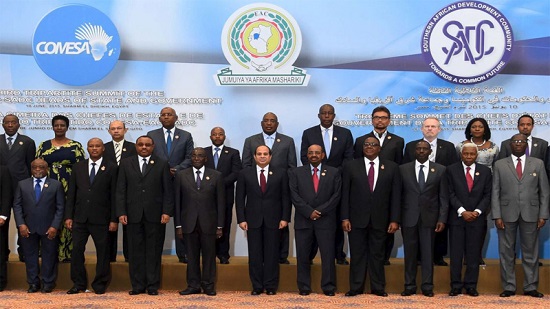
A year has passed since the heads of states and government of Africa's three economic blocs — COMESA, SADC and the East African Community (EAC) — met in Sharm El-Sheikh on 10 June 2015 to sign and launch the largest continental alliance through a free trade agreement (FTA) between the three blocs.
The reality of terrorism certainly extends far beyond the alleged definition the world has assigned to it. While the US depicts terrorism within the narrow frame of specific individual groups, such as Islamic State (IS), it is in fact a universal phenomenon that needs to be addressed not only structurally, but also from the motivational and environmental perspectives. Focusing on fighting IS alone will eventually weaken the group (as with Al-Qaeda previously), but as long as the root of the problem continues to exist, another terrorist group will emerge in due time.
I am sorry to say that despite officials’ nods to the importance of investment and the need to increase it and improve its climate, Egypt today does not have a clear investment policy or even an overall economic vision, as evidenced by the continued execution of plans and programs that have proved unsuccessful over the past two years.
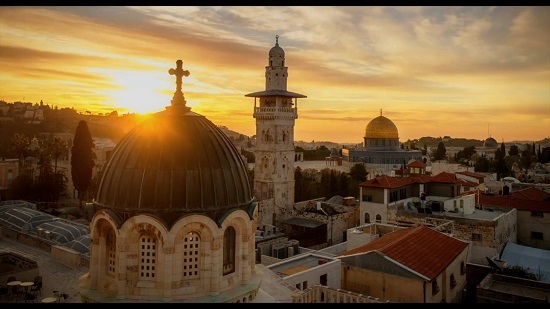
He who witnessed the flowing human river of last Friday going to pray in Al-Aqsa Mosque and he who saw crowds of tens of thousands pouring from all over Palestine towards Jerusalem will realise definitely that the attempts to isolate Jerusalem from its surroundings is still and will remain a failure.
Next week, the House of Representatives will discuss next fiscal year's budget, set to go into effect on July 1, 2016. Despite the few days allotted for debate, which will allow only the narrowest review and revision by the House, a discussion of the budget in and out of the parliament will provide an opportunity to understand and assess the government’s economic program, which is vital given the ambiguity of economic policies so far. So to make this debate more accessible to the general public, I’llattempt here only to highlight the general features of the budget and the challenges it poses, leaving analysis and opinion for another occasion.
Aridity: It is not so odd that the new preachers are dressed in the robes of hermits. What feels oddest is the state of caste they embody. Finding their origins in a wealthier class has inevitably and unwillingly presented them as preachers to that very social class, which is not degrading, as the existence of the essential least of religion is better than its vanishing.
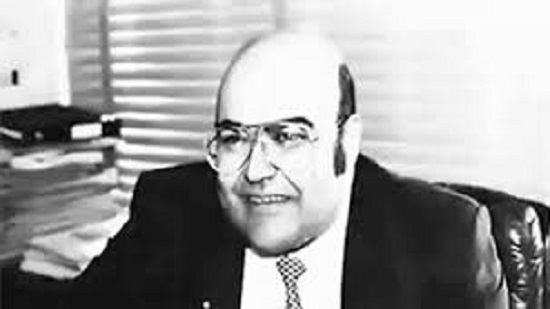
Ousted President Mohamed Morsi actually pardoned one of those convicted of the killing of Farag Fouda, and this man has since joined the Islamic State group in Syria. Fouda was a secular liberal who took part in the re-launch of the Wafd Party – the New Wafd as it was called – in the 1970s when late President Anwar El-Sadat allowed the presence of political parties. Fouda, however, resigned from the party when it decided to enter into an electoral alliance with the Muslim Brotherhood for the legislative elections. He insisted that joining hands with the Muslim Brotherhood ran counter to all secular principles the Wafd supposedly stood for. He was convinced that this alliance would mark the end of the Wafd as a leading civil party.
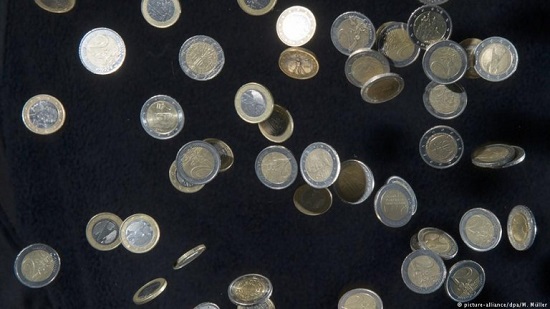
Germany’s highest court has ruled in favor of one of the European Central Bank’s (ECB) crisis-fighting tools, but the real problem facing the eurozone is chronically low interest rates, argues DW’s Christoph Hasselbach. It was to be expected that Germany’s constitutional court would neither totally dismiss the ECB’s anti-crisis measures nor give the green light without any reservations. From the beginning, the judges have been weighing a raft of legal, political and economic arguments. Judicial purists have always said that ECB chief Mario Draghi’s promise to buy unlimited amounts of government bonds from debt-stricken countries if need be violated the ECB’s mandate of not funding governments. Others countered by asking: What’s the point of interpreting the ECB’s mandate so strictly that it harms the common euro currency?
Others
First, I offer my sincere condolences to the martyrs who shed their pure blood as a result of the vicious terrorist act that targeted the Petrine Church in Cairo.